
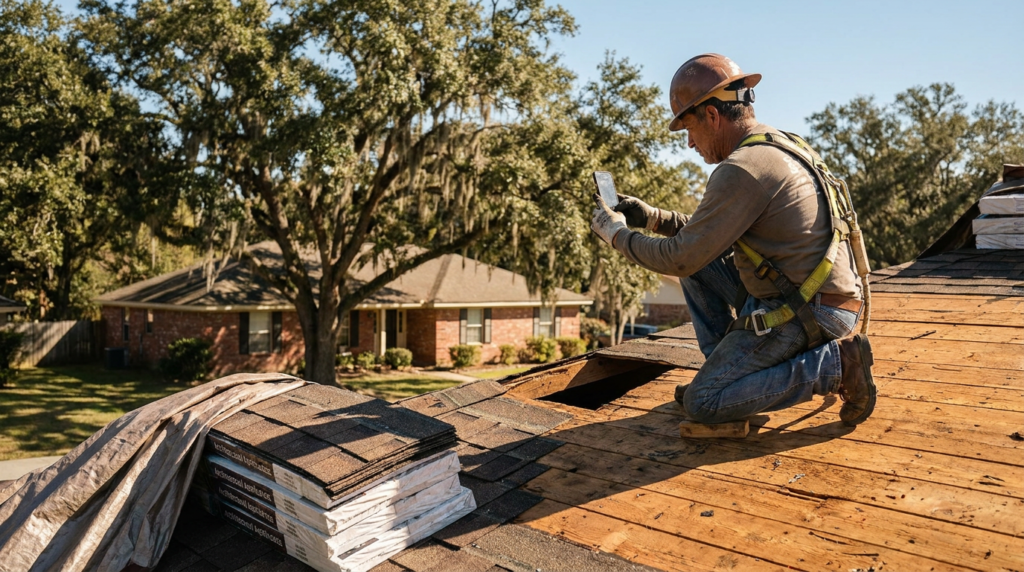
Yes. East Baton Rouge Parish requires a building permit for any roof replacement, and since Louisiana Act 239 took effect on August 1, 2025, the documentation standard has become considerably stricter than most homeowners expect. Reroofs now require staged photographic evidence submitted through the parish permitting portal, and the contractor doing the work must hold a Louisiana license if the job exceeds $7,500.
Most homeowners never see this process, because a reputable contractor handles it. But when it goes wrong — an unpermitted roof surfaces during a home sale, or an insurance claim is questioned because no permit exists — it becomes expensive and slow to fix. This guide covers what changed, what each parish around Baton Rouge requires, when a roof inspection is part of the process, and how to confirm your roofer is doing it properly.
What Louisiana Act 239 and Act 422 Changed
Two pieces of legislation reshaped Louisiana roofing compliance, both effective August 1, 2025.
Act 239 introduced the photographic documentation requirement for roof installations. Parishes now expect visual evidence at defined stages of the job rather than a single post-completion inspection. The intent is straightforward: hurricane performance depends on what happens under the shingles, and once the roof covering is on, nobody can verify the decking, fastening or underlayment without tearing it back off.
Act 422 tightened contractor licensing. From January 1, 2026, the residential roofing licensing rules apply in full, and under Louisiana Revised Statute 37:3737 a contractor performing residential work valued above $7,500 must hold the appropriate state license. Below that threshold the rules are lighter, which is precisely why some storm-chasing operations quote just under it.
Both sit on top of the 2021 International Residential Code as adopted by the Louisiana State Uniform Construction Code Council (LSUCCC), which sets the wind-load standards your roof has to meet. In the Baton Rouge area those design wind speeds fall in the 130 to 140 mph range — lower than the 150-plus mph required on the coast, but high enough that fastening patterns and edge-metal details are not optional.
Permit Requirements by Parish
Ryson Roofing works across five parishes, and the rules are not identical in any two of them. This is the part that trips up homeowners who moved from one side of a parish line to the other. Open the jurisdiction below that matches where the work is happening.
Parish Permit Checker
Open the jurisdiction where the work is happening to see what it requires.
East Baton Rouge Parish
Permit required
| Permit required for a reroof | Yes — applied for before work begins |
|---|---|
| Photo documentation | 16 photographs across 4 stages: 2 existing material, 4 decking, 4 underlayment, 6 roofing materials |
| Roofing Information Form | Required — records material, manufacturer, fastener type, fastener spacing per linear foot and decking thickness |
| Who applies | Your licensed contractor, not the homeowner |
| How to apply | Online through the parish permitting portal |
| Contractor license | Required for residential work above $7,500 under R.S. 37:3737 |
Note: Check first whether your address falls under the parish itself, the City of St. George, or a municipal office in Zachary, Baker or Central — each has its own permitting authority.
City of St. George
Permit required
| Permit required for a reroof | Yes |
|---|---|
| Permitting authority | Incorporation split permitting authority away from East Baton Rouge Parish |
| Before applying | Confirm which office holds jurisdiction for your specific address |
| Contractor license | Required for residential work above $7,500 under R.S. 37:3737 |
Note: This is the most common point of confusion in the area. Applying to the wrong office delays the job.
Zachary, Baker or Central
Permit required
| Permit required for a reroof | Yes |
|---|---|
| Permitting authority | Each city operates its own permit office within East Baton Rouge Parish |
| Before applying | Apply to the municipal office for your city, not the parish |
| Contractor license | Required for residential work above $7,500 under R.S. 37:3737 |
Note: Being inside East Baton Rouge Parish geographically does not mean the parish issues your permit.
West Baton Rouge Parish
Permit required
| Permit required for a reroof | Yes |
|---|---|
| Verification method | Either an inspection by an LSUCCC-licensed third-party provider, or geo-tagged photographs supplied by the installer |
| What to confirm | Ask your contractor which of the two routes they are using before work starts |
| Contractor license | Required for residential work above $7,500 under R.S. 37:3737 |
Note: The third-party inspection option changes who signs off on the work — worth knowing which route applies to your job.
Livingston Parish
Permit required
| Permit required for a reroof | Yes |
|---|---|
| Permitting authority | Separate parish permit office |
| Fees | Verify the current fee schedule at the time of application |
| Contractor license | Required for residential work above $7,500 under R.S. 37:3737 |
Note: Livingston Parish is one of the parishes eligible for the Louisiana Fortify Homes Program, which East Baton Rouge Parish is not.
Ascension Parish
Permit required
| Permit required for a reroof | Yes |
|---|---|
| Permitting authority | Separate parish permit office serving Gonzales, Prairieville and surrounding areas |
| Fees | Verify the current fee schedule at the time of application |
| Contractor license | Required for residential work above $7,500 under R.S. 37:3737 |
Note: Ascension Parish is also eligible for the Louisiana Fortify Homes Program.
Request a Free Roof Inspection
If you are outside East Baton Rouge, the West Baton Rouge Parish process is worth understanding in particular, because the third-party inspection option changes who signs off on the work. Full details are published on the West Baton Rouge Parish roofing permit page.
We handle permitting as part of every job, whether that is roofing in Livingston Parish or roofing in Gonzales, because the requirements differ enough that a homeowner shouldn’t have to track them.
How to Pull a Reroof Permit in East Baton Rouge Parish
The parish publishes its residential permitting requirements directly, and roofing replacement is explicitly named among the work that requires a permit. You can read the parish’s own list on the East Baton Rouge residential permits page.
The process runs roughly as follows:
- Confirm jurisdiction. Establish whether your address falls under East Baton Rouge Parish, the City of St. George, or one of the municipal offices in Zachary, Baker or Central.
- Verify the contractor’s license. For any job above $7,500, the contractor must hold a current Louisiana license in good standing.
- Apply through the parish permitting portal before work begins. Applications are submitted online rather than in person.
- Complete the Roofing Information Form. This captures the roofing material, manufacturer, fastener type, fastener spacing per linear foot, and decking thickness.
- Photograph the job at each required stage as work progresses — this cannot be reconstructed afterward.
- Submit documentation and close the permit. An open permit on a property causes problems at resale.
The single most common failure is step five. Once the roof covering is installed, the decking and underlayment photographs are impossible to capture, and the permit cannot be closed without them.
The Photographs East Baton Rouge Requires
This is the part of Act 239 that surprises people. East Baton Rouge Parish requires photographic evidence across four distinct stages of the job, totaling 16 photographs. The parish publishes the full requirement in its roof permits and installations document.
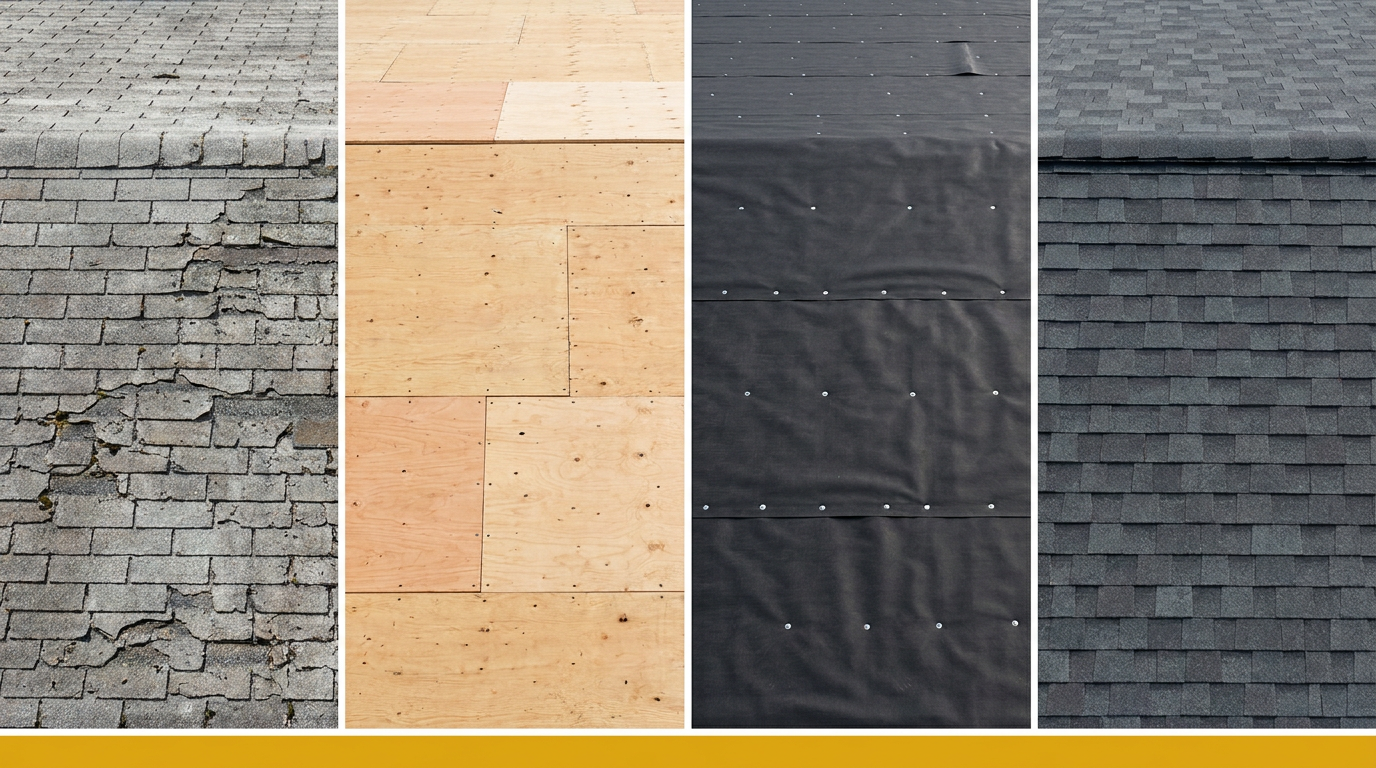
| Stage | Photographs | What it proves |
|---|---|---|
| Existing roof material (reroofs only) | 2 | Condition and material of the roof being removed, including a wide-angle shot |
| Decking | 4 | Substrate condition and any replaced sheathing after tear-off |
| Underlayment | 4 | Water barrier installation before the covering goes on |
| Roofing materials | 6 | Final installation, fastening and detail work |
Alongside the photographs, the Roofing Information Form records fastener spacing per linear foot at the edge and in the field. That detail matters more than it sounds: edge fastening is where wind uplift failures begin, and it is the difference between a roof that survives a 130 mph design event and one that peels.
If a contractor tells you photographs aren’t necessary, that is a reliable signal they have not pulled a permit in East Baton Rouge Parish recently.
What Happens During a Roofing Inspection
A roofing inspection verifies that the work meets code before the permit can be closed. In East Baton Rouge Parish, Act 239 shifted most of that verification to the staged photographs described above — the images are the inspection record, which is why they cannot be skipped or recreated later. In West Baton Rouge Parish, the parish instead accepts either a physical inspection by an LSUCCC-licensed third-party provider or geo-tagged photographs from the installer, so the route your contractor chooses determines who signs off.
That permit inspection is a different thing from the roof inspection a homeowner requests, and the two get confused constantly. A homeowner roof inspection is a condition assessment. There is no permit attached to it, and you can request one at any time.
Most Baton Rouge homeowners have a roof inspection carried out for one of four reasons:
- After a storm. Wind and hail damage is frequently invisible from the ground. Documenting it early matters, because Louisiana insurance claim deadlines are unforgiving.
- Before buying or selling. A roof inspection during the transaction is where unpermitted work and deferred maintenance tend to surface.
- For an insurance claim or renewal. Carriers increasingly ask for evidence of roof condition and age.
- Before storm season. An annual check on fastening, flashing, sealant and edge metal is the cheapest maintenance available on a roof.
A thorough roof inspection covers the roof covering itself, the flashing at every penetration and wall junction, the condition of edge metal and drip edge, gutters and drainage, and the attic — where moisture staining, daylight at the deck and inadequate ventilation reveal problems that are not visible from outside. On a metal roof inspection the emphasis shifts to fastener backout, panel movement and sealant condition at the seams and penetrations rather than to granule loss.
The inspector should give you photographs and a written assessment, not a verbal summary and a quote. If the only output is a price to replace the roof, that was a sales call, not an inspection. Ryson Roofing provides free roof inspections across residential roofing Baton Rouge homeowners rely on, and you receive the documentation whether or not you hire us for the work.
When a Repair Needs a Permit — the 50% Rule
Not every roofing job requires a permit. The general threshold used across Louisiana jurisdictions is whether the work affects more than 50% of the roof covering. Below that, it is typically treated as a repair. Above it, it is a replacement and requires a permit and the full documentation package.
Where homeowners get caught out is incremental work. Repairing one slope this year and another next year can, in practice, add up to a full replacement performed without a permit. If a contractor proposes splitting a job into stages specifically to stay under the threshold, that is worth questioning — it is the homeowner, not the contractor, who owns the unpermitted work afterward.
Structural changes to the roof or ceiling require a permit regardless of the percentage of covering involved.
Choosing a Roofing Contractor Who Handles Permits Correctly
The permit process is one of the clearest tests of whether a roofing contractor actually works in your parish. Roofers who handle the permit process routinely can describe it without hesitation; those who don’t will minimize it. Texas famously does not license roofing contractors. Louisiana does, and Act 422 strengthened it.
Before signing anything for a job over $7,500:
- Confirm the Louisiana contractor license is current and in good standing under R.S. 37:3737.
- Ask who is pulling the permit. If the answer is “you are,” that is a significant red flag — it shifts liability for the work onto the homeowner. A contractor who handles permits properly pulls it themselves, as a matter of course.
- Ask how they handle the staged photographs. A roofer familiar with local building codes and the East Baton Rouge process will answer this immediately, and will know that the count is 16 across four stages.
- Ask which office they apply to for your address. A contractor familiar with local permits will distinguish between the parish, St. George, and the Zachary, Baker and Central municipal offices without being prompted.
- Verify general liability and workers’ compensation coverage. Request the certificates rather than taking the assurance.
- Check for a physical local address. Post-storm operations working from a truck and a phone number disappear when a warranty claim arrives.
Our own licensing and manufacturer certifications are published rather than described, which is a standard worth applying to anyone you’re considering for Baton Rouge roofing work.
What Happens if a Roof Was Replaced Without a Permit
Unpermitted roofing work tends to surface at the worst possible moment. The three most common are:
At resale. A title search or buyer’s inspection reveals an open or missing permit. Closing gets delayed while it is resolved, and resolution can mean opening the roof back up to document what is underneath.
During an insurance claim. Carriers may question coverage on work that was never inspected or permitted, particularly after a named storm where the failure mode points to installation quality.
At the next replacement. When the roof is eventually redone properly, the permitting office may require evidence of what was previously installed — evidence that does not exist.
The remedy is usually a retroactive permit application, which is more expensive and slower than doing it correctly, and sometimes requires exposing sections of the roof. It is worth avoiding.
FAQs
Do I need a permit to replace my roof in Baton Rouge?
Yes. East Baton Rouge Parish requires a building permit for roof replacement, and the parish names roofing replacement explicitly among permitted residential work. Your contractor should pull it before starting.
Who is supposed to pull the permit, me or my roofer?
Your licensed contractor should pull it. If a roofer asks the homeowner to pull the permit, that shifts responsibility for the work onto you and is a common warning sign of an unlicensed operator.
What is Louisiana Act 239?
Act 239 took effect August 1, 2025 and introduced photographic documentation requirements for roof installations in Louisiana. East Baton Rouge Parish implements it as a 16-photograph requirement across four stages of the job.
What does Act 422 change for homeowners?
Act 422 tightened residential roofing contractor licensing, with rules applying in full from January 1, 2026. Under R.S. 37:3737, a contractor performing residential work above $7,500 must hold the appropriate Louisiana license.
Does a small roof repair need a permit?
Generally no. The common threshold is 50% of the roof covering — work below that is usually treated as a repair. Structural changes to the roof or ceiling require a permit regardless of size.
How many photographs does East Baton Rouge Parish require?
Sixteen, across four stages: 2 of the existing roof material on reroofs, 4 of the decking, 4 of the underlayment, and 6 of the roofing materials. They must be taken as the work progresses.
Is the permit process the same in West Baton Rouge Parish?
No. West Baton Rouge requires either an inspection by an LSUCCC-licensed third-party provider or geo-tagged photographs supplied by the installer. Confirm which route your contractor is using.
What wind speed does my roof have to be built for in Baton Rouge?
Design wind speeds in the Baton Rouge area fall in the 130 to 140 mph range under the 2021 IRC as adopted by the LSUCCC. Coastal parishes require 150 mph or higher.
What happens if my roof was replaced without a permit?
It typically surfaces at resale, during an insurance claim, or at the next replacement. Resolving it usually means a retroactive permit application, which costs more and can require exposing sections of the roof to document what is underneath.
How do I check whether a roofing contractor is licensed in Louisiana?
Ask for the license number and confirm it is current and in good standing. For any job above $7,500 a Louisiana license is required, and a legitimate contractor will provide the number without hesitation.
Yes. East Baton Rouge Parish requires a building permit for roof replacement, and the parish names roofing replacement explicitly among permitted residential work. Your contractor should pull it before starting.
Your licensed contractor should pull it. If a roofer asks the homeowner to pull the permit, that shifts responsibility for the work onto you and is a common warning sign of an unlicensed operator.
Act 239 took effect August 1, 2025 and introduced photographic documentation requirements for roof installations in Louisiana. East Baton Rouge Parish implements it as a 16-photograph requirement across four stages of the job.
Act 422 tightened residential roofing contractor licensing, with rules applying in full from January 1, 2026. Under R.S. 37:3737, a contractor performing residential work above $7,500 must hold the appropriate Louisiana license.
Generally no. The common threshold is 50% of the roof covering — work below that is usually treated as a repair. Structural changes to the roof or ceiling require a permit regardless of size.
Sixteen, across four stages: 2 of the existing roof material on reroofs, 4 of the decking, 4 of the underlayment, and 6 of the roofing materials. They must be taken as the work progresses.
No. West Baton Rouge requires either an inspection by an LSUCCC-licensed third-party provider or geo-tagged photographs supplied by the installer. Confirm which route your contractor is using.
Design wind speeds in the Baton Rouge area fall in the 130 to 140 mph range under the 2021 IRC as adopted by the LSUCCC. Coastal parishes require 150 mph or higher.
It typically surfaces at resale, during an insurance claim, or at the next replacement. Resolving it usually means a retroactive permit application, which costs more and can require exposing sections of the roof to document what is underneath.
Ask for the license number and confirm it is current and in good standing. For any job above $7,500 a Louisiana license is required, and a legitimate contractor will provide the number without hesitation.
Getting It Done Properly
Permitting is not the interesting part of a roofing project, but it is the part that determines whether the work holds up when it is examined — by a buyer, an adjuster, or a hurricane. We pull the permit, complete the Roofing Information Form, and capture the staged photographs on every roof replacement in Baton Rouge, and we do the same across all of our roofing services throughout Southeast Louisiana.
If you are planning a replacement, or you have inherited a roof and are not sure whether it was permitted, we will take a look and tell you where you stand. Request a free roof inspection and we will document the condition of your roof and explain what the parish will require.