Ryson Roofing installs and repairs reflective TPO roofing for Baton Rouge commercial buildings, offering heat-welded seams, 20 to 30 year lifespans, and strong energy savings. Backed by Owens Corning/CertainTeed certifications and 25+ years of experience, they build hurricane-ready systems suited to Louisiana’s climate.
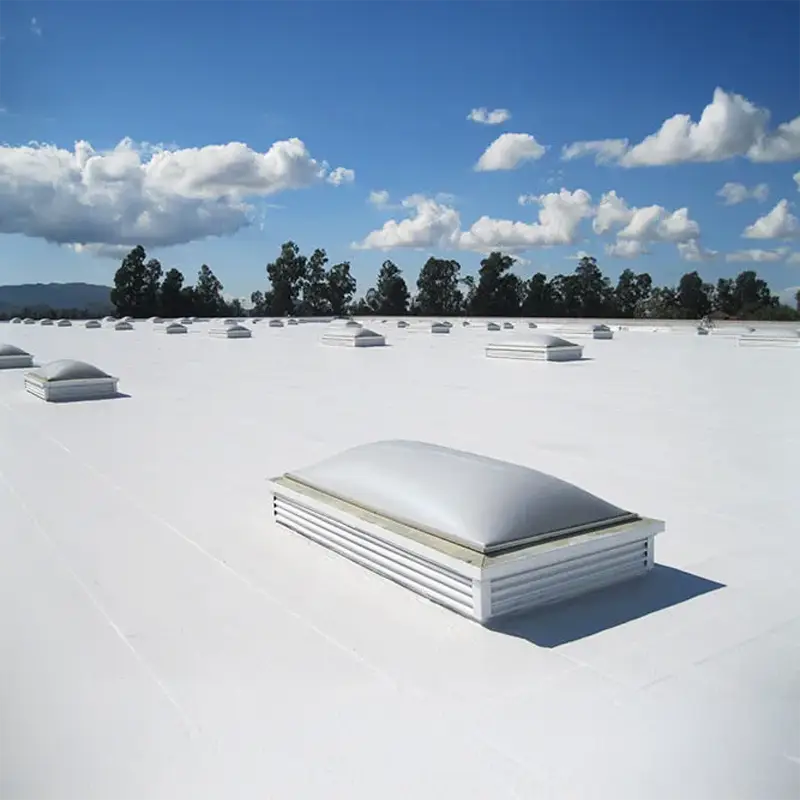
TPO roofing is a single-ply membrane made for flat and low-slope roofs, known for its bright white, reflective surface and heat-welded seams that lock out water. Ryson Roofing installs and repairs TPO roofs for commercial buildings and homes across Baton Rouge, matching the right membrane thickness to your building and backing every job with strong warranties. As a family-owned roofing contractor at 14858 South Harrells Ferry Road, we install TPO the way it is meant to go on, with every seam welded and tested.
TPO stands for thermoplastic polyolefin, a blend of polypropylene and rubber reinforced with a woven scrim for strength. It has become the most common single-ply system in the country because it pairs a lower price with the energy savings and seam strength once found only in pricier membranes.
In a climate like ours, the reflective surface is a real advantage. A white TPO membrane bounces sunlight instead of soaking it up, which lowers the heat load on your building and cuts cooling costs through the long Baton Rouge summer. The U.S. Department of Energy notes that reflective roofs can stay much cooler than dark roofs, easing the strain on your air conditioning.
TPO is a flexible white membrane that arrives in wide rolls, often 10 to 12 feet across, and is rolled out over insulation on a flat or low-slope roof. The sheets are joined with hot air that fuses them into one continuous surface. These heat-welded seams are three to four times stronger than the taped seams on older rubber roofs, which is why seam failure, the classic weak point of flat roofing, is far less common on a well-installed TPO roof.
The membrane comes in several thicknesses, most often 45, 60, and 80 mil. Thicker membranes stand up better to sun, weather, and foot traffic, so the right choice depends on your building and how the roof is used. TPO carries a Class A fire rating and is recyclable at the end of its life.
TPO has earned its popularity for good reason. For Baton Rouge buildings, the main advantages are:
No roofing system is perfect, and being straight about the tradeoffs helps you choose well. A few things to keep in mind with TPO:
We help you weigh these against your building and budget so the system fits the way you use your roof.
TPO is one of several low-slope options, and the best pick depends on the building. Compared with EPDM, a black rubber membrane, TPO reflects heat instead of absorbing it and uses stronger welded seams, though EPDM often costs a little less and has a longer track record. Compared with PVC, TPO costs less but resists grease and chemicals less well. For a full side-by-side of every system we install, see our flat roof systems page.
Membrane | How It Compares to TPO | Best For |
EPDM (rubber) | Costs a bit less and has a longer track record, but absorbs heat instead of reflecting it and relies on glued or taped seams rather than heat-welded ones | Buildings prioritizing lower upfront cost over energy savings |
PVC | Outperforms TPO on grease and chemical resistance, but typically costs more | Restaurants and buildings with rooftop kitchen exhaust or chemical exposure |
Modified bitumen | Handles foot traffic and punctures better, but generally has a shorter lifespan and less reflectivity | High-traffic roofs or buildings with frequent rooftop equipment servicing |
Built-up roofing (BUR) | Offers more redundancy through multiple layers, but costs more to install and repair | Large, complex, or older-style commercial roofs |
TPO is the workhorse of commercial flat roofing, and Ryson Roofing installs and maintains it on offices, retail buildings, warehouses, and multi-unit properties across the Baton Rouge area. We schedule every project around your building’s hours and tenant needs, so daily operations keep running while the work happens overhead. Explore our full commercial roofing services, and if you manage housing or office space, our apartment and multifamily roofing and office building roofing teams work from a single point of contact so your project doesn’t fall between departments.
After a Gulf Coast storm, our storm damage roof repair crews respond fast, since TPO seams and flashing details are especially vulnerable to wind-driven rain and standing water in the hours immediately following severe weather.
TPO membrane isn’t attached the same way on every building, and choosing the right method comes down to your roof deck, how much wind exposure the building faces, and what your budget allows. Ryson Roofing evaluates each of these factors before recommending an approach.
TPO membranes hold up well, but they still give warning signs before a small issue becomes a costly one. Watch for these signs, and schedule an inspection if you notice any of them.
If any of these sound familiar, don’t wait. Catching a seam or flashing issue early is almost always a far less expensive fix than the interior damage a lingering leak leaves behind.
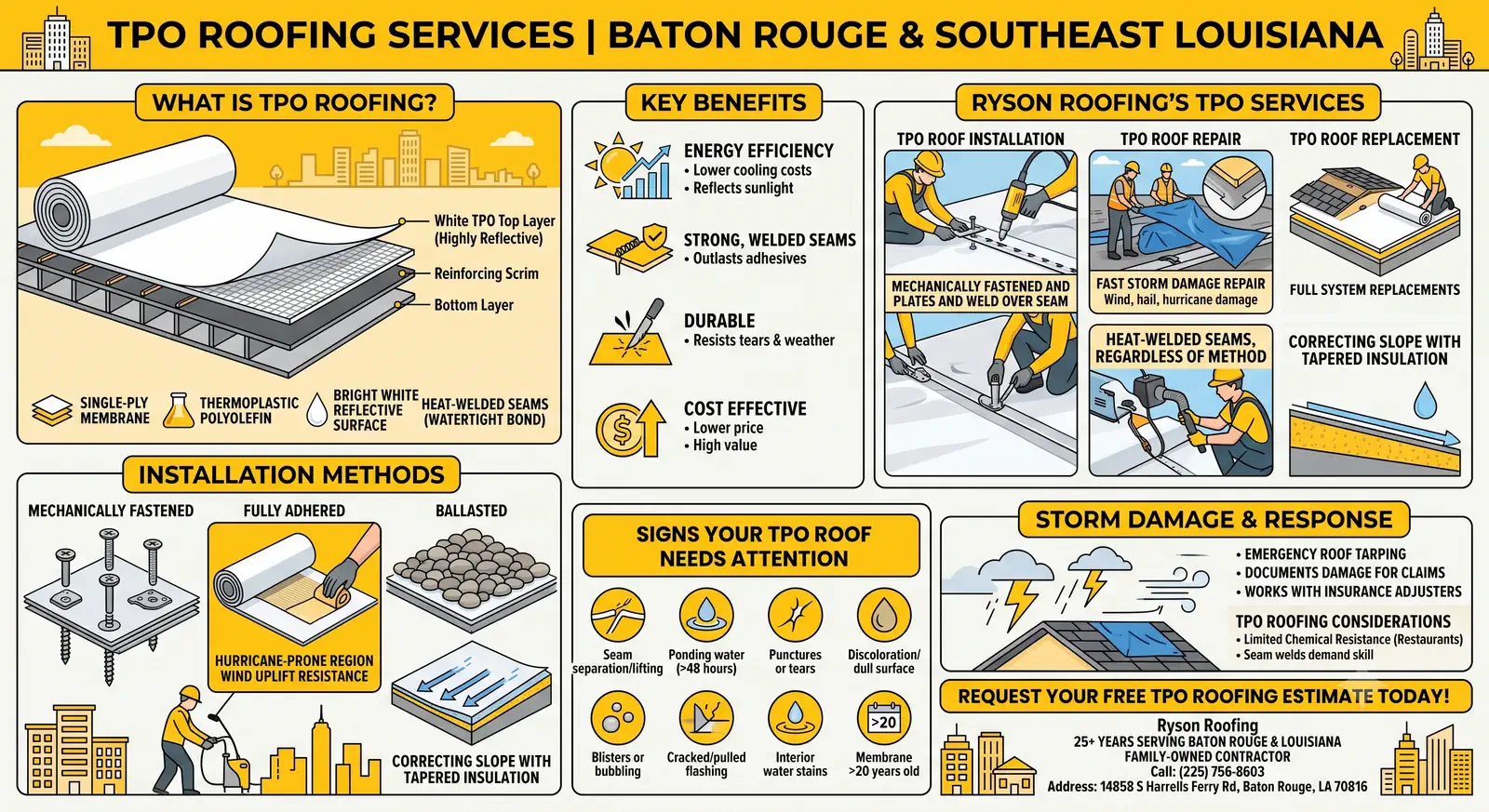
A TPO membrane holds up well against heat and rain, but severe weather targets it differently than everyday wear. Our storm damage team responds fast to hail damage that can bruise or puncture the membrane, wind damage that lifts seams and displaces ballast, and full hurricane roof damage after a named storm passes through. When your building needs attention right now, our emergency roof repair team provides roof tarping to secure exposed sections immediately.
If your TPO roof sustained storm damage, we document everything with photos and detailed notes and can work directly with your adjuster through the roof insurance claims process, so your claim reflects the true scope of the repair or replacement needed.
Square footage is only the starting point. The line items below are what typically move a TPO project’s final number up or down for buildings across the Baton Rouge area.
Cost Driver | Low End | High End | What Affects This Range |
Mechanically attached, 45-mil membrane | $6 per sq ft | $9 per sq ft | Deck condition, fastener spacing, number of roof penetrations |
Mechanically attached, 60-mil membrane | $7 per sq ft | $11 per sq ft | The standard thickness most Baton Rouge commercial buildings specify |
Fully adhered, 60-mil membrane | $9 per sq ft | $13 per sq ft | Substrate prep, adhesive volume, and wind uplift design requirements |
Fully adhered, 80-mil membrane | $11 per sq ft | $14 per sq ft | Heavier foot traffic areas or buildings wanting maximum durability |
Tapered insulation correction | $1 to $3 per sq ft additional | Varies | Target R-value, current slope condition, drain locations |
Deck sheet replacement | $75 to $150 per sheet | Varies | Number of rotted or water-damaged sheets found once the old roof comes off |
Full tear-off of existing roof | $1 to $2 per sq ft additional | Varies | Number of layers already on the roof and disposal weight |
Flashing and penetration work | Moderate | Significant | Count of HVAC units, skylights, pipe boots, and parapet wall details |
Typical full project total | $30,000 | $150,000+ | Overall square footage combined with the factors above |
Two things push Baton Rouge numbers higher than a national average: hurricane-driven wind uplift requirements often push buildings toward fully adhered systems even when mechanical attachment would otherwise be the cheaper route, and older commercial buildings in this region frequently need more deck repair than newer construction elsewhere. We walk every building individually and provide a written, itemized estimate after inspection so you’re working from real numbers rather than a rough average.
TPO membranes require less upkeep than many other flat roof systems, but skipping maintenance entirely shortens a roof that could otherwise reach its full 20 to 30 year lifespan. Stay on top of these tasks to protect the investment.
Frequency | Maintenance Task | Why It Matters |
Twice a year | Walk the roof and check every seam for lifting, separation, or debris buildup | Seam integrity is the primary defense against water intrusion on any TPO system |
Twice a year | Clear drains, scuppers, and gutters of debris | Blocked drainage is one of the fastest ways to shorten a TPO membrane’s life |
Quarterly | Inspect flashing and sealant around HVAC curbs, vents, and pipe boots | These penetration points are where most TPO leaks actually originate |
After every major storm | Check for punctures, tears, or displaced ballast | Wind-driven debris can damage a membrane without an obvious sign from the ground |
Within 48 hours of heavy rain | Confirm no standing water remains on the roof surface | Prolonged ponding accelerates membrane breakdown and adds structural load |
Annually | Assess the membrane’s reflectivity and surface condition | Dirt buildup and UV wear gradually reduce the energy savings TPO is known for |
Every 10 to 15 years | Consider a professional recoat or seam re-inspection | Extends service life on membranes that are aging but still structurally sound |
Staying on top of this schedule protects both your roof and your manufacturer warranty. If your building hasn’t had a professional TPO inspection recently, we’re happy to start with a free one.
We keep every TPO project transparent and scheduled around your building’s operations, so you always know what’s happening and why.

Ryson Roofing brings the same precision seam welding, hurricane-ready attachment methods, and manufacturer-backed warranties to TPO roofing projects throughout Baton Rouge and the surrounding parishes, including St. George, Prairieville, Denham Springs, Central, Zachary, Livingston, Walker, Hammond, and Gonzales. For a full view of our coverage, see our service area page. No matter which of these communities your commercial property is in, your TPO roof gets the same certified craftsmanship and welded seam quality behind every installation.
Whether you’re installing a new TPO membrane, restoring an aging one, or repairing seam failures after a storm, the right attachment method and installation quality make all the difference. We factor Louisiana’s wind uplift requirements into every recommendation, not just cost, so your roof holds up when hurricane season tests it. With 25+ years serving Baton Rouge businesses, we know exactly how to build a TPO system that lasts in this climate.
Call (225) 756-8603 or request your free commercial roof inspection online to get started.
Address: 14858 S Harrells Ferry Rd, Baton Rouge, LA 70816
Email Address: info@rysonroofing.com
Phone Number: (225) 756-8603
Business Hours:
Monday: Open 24 hours
Tuesday: Open 24 hours
Wednesday: Open 24 hours
Thursday: Open 24 hours
Friday: Open 24 hours
Saturday: Open 24 hours
Sunday: Open 24 hours
TPO (thermoplastic polyolefin) is a single-ply roofing membrane made from a blend of polypropylene and rubber, reinforced with a woven scrim for strength. It comes in wide white rolls that are heat-welded at the seams to form one continuous, watertight surface. TPO is built for flat and low-slope roofs on both commercial and residential buildings.
A quality TPO roof lasts 20 to 30 years with good installation and regular maintenance. Thicker membranes, such as 80-mil, hold up longer than thin 45-mil sheets, and yearly inspections that catch seam or flashing issues early add years to the roof.
Installed TPO roofing runs about $5 to $12 per square foot in 2026, depending on membrane thickness, insulation, roof size, and access. We give you a clear, written estimate after a free inspection, so you know the price before any work begins.
TPO has a few. Its seams must be heat-welded with skill, since a poor weld is the top cause of leaks. It resists grease and harsh chemicals less well than PVC, so restaurants may prefer PVC, and thin membranes can puncture under heavy foot traffic. Choosing a quality thickness and an experienced installer solves most of these.
It depends on your priorities. The white TPO surface reflects heat and cuts cooling costs, and its heat-welded seams are stronger than EPDM’s taped seams. EPDM, a black rubber membrane, often costs less and has a longer track record. The right choice comes down to your building, climate, and budget.
Yes, TPO handles normal foot traffic for inspections and maintenance, but repeated heavy traffic can wear or puncture the membrane. For roofs with regular rooftop access, we add walkway pads to protect the surface.
Call us today at (225) 756-8603 or schedule a free roof estimate online and let Ryson Roofing put a roof over your head that's built to last.