Ryson Roofing delivers wind damage roof repair in Baton Rouge, fixing broken seals, creased shingles, and lifted flashing before leaks develop. Backed by Owens Corning/CertainTeed certifications and 25+ years of experience, they document damage for insurance claims and rebuild with wind-rated or FORTIFIED systems.
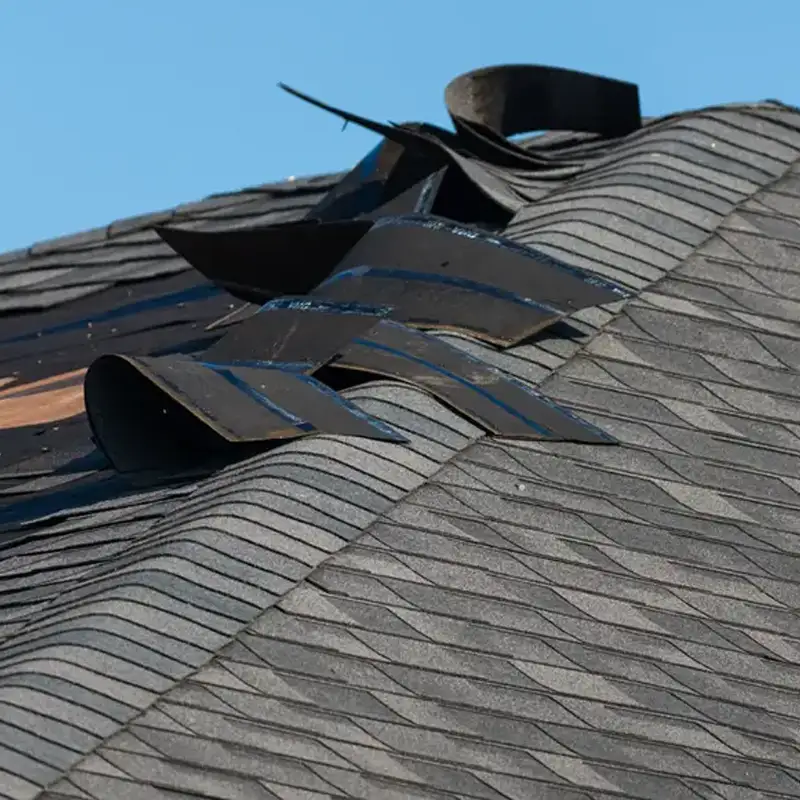
Wind is the most common cause of roof damage in Baton Rouge, and the trickiest to spot. It does not take a hurricane. Louisiana has recorded more than 2,500 tornadoes since 1950, and every thunderstorm season brings straight-line winds, squalls, and gusts that can break the seal under your shingles, lift and crease them, and peel back flashing, often leaving the roof looking fine from the street while water works its way underneath.
Ryson Roofing has handled wind damage roof repair across the Baton Rouge area for more than 25 years. We spot the lifted, creased, and missing shingles, document them for your insurer, and put the roof back to full strength. Wind is one form of storm damage we repair, alongside hail and hurricane damage.
Wind seldom tears a roof off in one piece. It works by suction. As wind flows over and around a house, it speeds up at the edges and creates negative pressure, a vacuum that pulls up on the shingles rather than pushing down on them. That uplift is strongest at the roof’s edges, corners, and ridge, which is why wind damage almost always starts there and moves inward.
According to the National Weather Service, damaging straight-line winds from thunderstorms are actually far more common than tornadoes across most of the country, and Louisiana’s summer storm season regularly produces gusts strong enough to break a shingle’s seal well before a named storm or tornado ever forms. Each asphalt shingle relies on a thin strip of adhesive to bond to the course below. Once uplift breaks that seal, the shingle is free to flutter, and every gust after that works it looser until it creases, tears, or blows away. It is a progressive failure, and the earliest stage, a broken seal, is the one you cannot see from the ground.
Wind damages a roof in stages, and the early stages hide in plain sight. High wind can:
A broken seal or a creased shingle is the damage homeowners miss most, and it is the damage that turns into leaks in the next storm.
After a windy storm, walk your property and look for:
Wind damage is progressive, so even a few lifted shingles are worth a free inspection before the next storm finishes the job.
Not every windstorm calls for a full roof replacement, and the right call depends on how far the damage has actually spread once we check every slope up close.
Situation | Recommended Solution | Why It Matters |
A few isolated lifted or missing shingles | A targeted fix reseals or replaces the affected shingles without the cost of redoing the whole roof | |
Damage limited to flashing or ridge caps | Repair | These components can be resecured or replaced individually while the shingle field remains sound |
Creased or broken seals spread across multiple slopes | Replacement | Widespread progressive damage means more shingles are likely to fail with the next storm, even if they look intact today |
Matching shingles are no longer available | Replacement | A visible mismatch on a repaired section often strengthens the case for replacing the full slope or roof instead |
Roof already near the end of its expected lifespan | Replacement | Wind damage on an aging roof often accelerates problems that were already close to requiring a full replacement |
More than 25 percent of the roof affected | Replacement | Many insurance policies and local codes treat this threshold as the point where replacement becomes the standard, cost-effective path |
An inspection is what actually settles this question for your roof, since wind damage that looks minor from the ground, a few flapping shingles, can mean many more have already lost their seal and just haven’t blown off yet. We give you the honest read on which category your roof falls into, and we document our findings clearly enough to support whichever path your insurance claim takes.
Less than most homeowners think. Wind damage can begin around 45 mph, the kind of gust a routine Louisiana thunderstorm produces, and older roofs or roofs with worn seals give way first. Once gusts reach 58 to 74 mph, wind can tear off shingles that were in good condition, and above 75 mph the damage turns severe. Baton Rouge sits in a 130 mph design wind zone, and the straight-line winds in a strong summer storm can reach 70 to 90 mph on their own, before a single named storm forms. Because a forecast sustained wind of 50 mph can gust well past 70, it does not take a hurricane to leave you needing repairs.
Not all shingles hold up to wind the same way, and the difference is measured by two industry tests. ASTM D3161 uses fans to rate shingles at 60, 90, or 110 mph, with Class F at 110 mph the top mark. ASTM D7158 measures uplift resistance and rates shingles Class D, G, or H, with Class H rated to 150 mph, the highest available.
Building codes in high-wind regions accept ASTM D3161 Class F or ASTM D7158 Class H shingles at all wind speeds, which is what you want on a Baton Rouge roof. Basic 3-tab shingles often carry only a 60 mph rating, while quality architectural shingles reach Class F or Class H. Insurers pay attention too, and many offer a discount of 5 to 25 percent for wind-rated shingles. When we replace a wind-damaged roof, we install shingles rated for our climate and note the rating for your insurer.
Homeowner policies in Louisiana cover sudden wind damage, but the subtle nature of broken seals and creased shingles is where claims get denied. Ryson documents wind damage the way adjusters need it, meets your adjuster at the roof, and guides you through the roof insurance claim process and each claim step. Wind claims fall under your wind and hail deductible, and Louisiana gives you time to file after a storm, but the sooner the damage is documented, the stronger your claim. If a shingle match is not available, that can also strengthen the case for replacing the full slope or roof rather than patching a visible mismatch.
When wind takes your roof, the rebuild is a chance to do better. Architectural shingles rated to ASTM D3161 Class F or D7158 Class H, metal roofing that resists 140 mph or more, and correct nailing and sealing all raise a roof’s wind resistance. The strongest option is a FORTIFIED roof built to the IBHS standard.
FORTIFIED targets the exact points where wind gets in: it requires a sealed roof deck that keeps the home dry even if shingles blow off, ring-shank nails in an enhanced pattern with about double the holding strength, and wind-rated shingles and reinforced edges. Louisiana requires insurers to offer premium discounts on FORTIFIED roofs, and the state Fortify Homes program has funded thousands of upgrades with grants of up to $10,000. Ask us how to fold a wind upgrade into your repair.
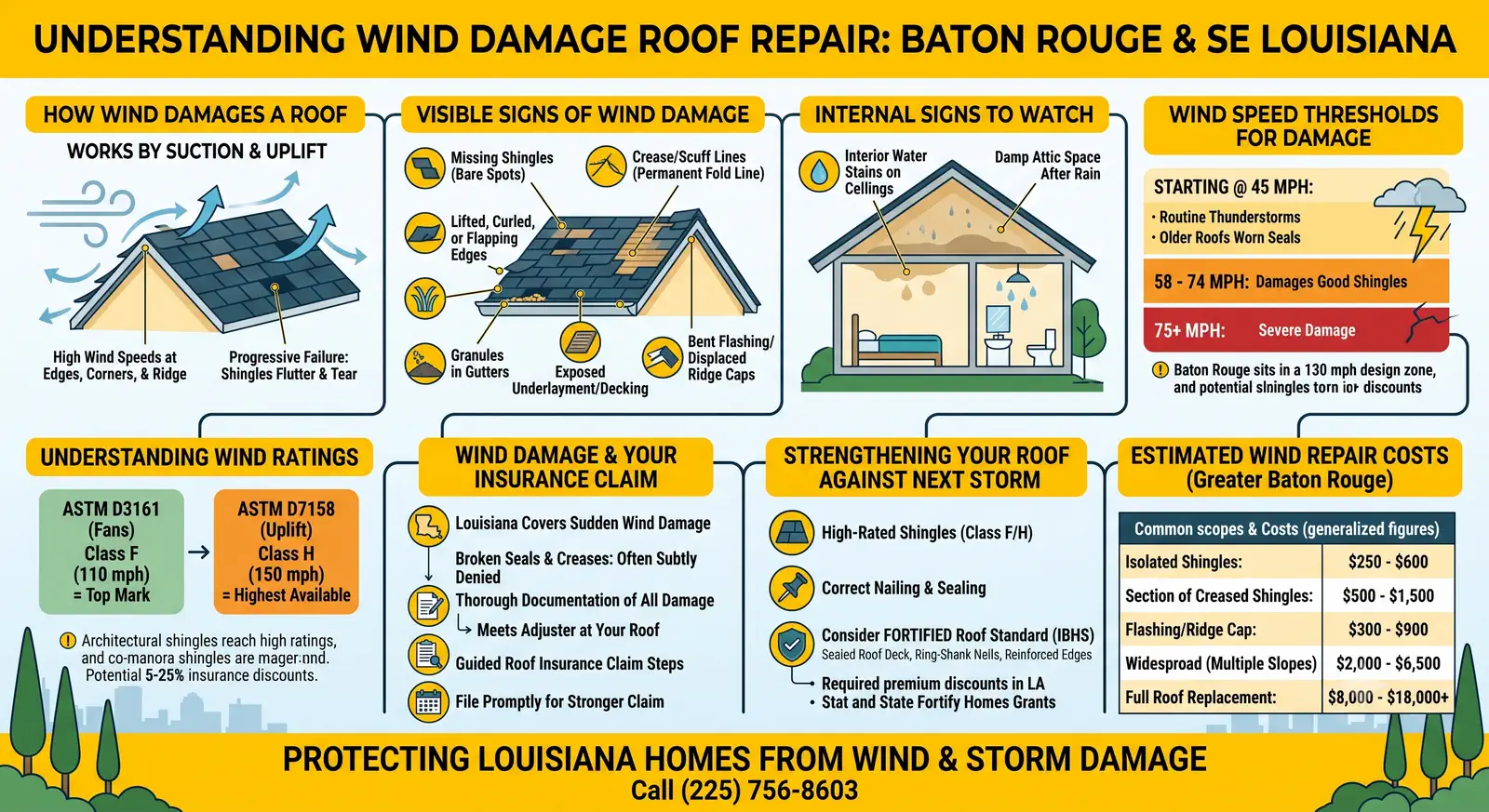
Wind repair costs vary based on how many shingles lost their seal, whether flashing or ridge caps also pulled loose, and whether a matching shingle is still available. Use this table as a general starting point, then get a written estimate after your free inspection for an exact number.
Damage Scope | Typical Repair Cost | Common Scope |
A few lifted or missing shingles | $250 to $600 | Resealing loosened tabs and replacing isolated missing shingles |
Creased shingles across one section | $500 to $1,500 | Replacing a full section of weakened, creased shingles |
Flashing and ridge cap damage | $300 to $900 | Resecuring or replacing bent flashing and displaced ridge caps |
Widespread damage across multiple slopes | $2,000 to $6,500 | Repairing several sections or a full slope of the roof |
Full roof replacement due to widespread wind damage | $8,000 to $18,000+ | Complete tear-off and replacement, often covered under your wind and hail deductible |
Upgrade to wind-rated shingles (Class F or Class H) | Add 10 to 20 percent to material cost | Higher wind-resistance rating that can also qualify for an insurance discount |
These figures assume a standard residential roof and shift based on roof size, pitch, and material. When wind is the cause, much of this cost is often covered by insurance under your wind and hail deductible, and we document the damage thoroughly to support your claim. If a deductible or urgent repair catches you off guard, roof financing is available. We always provide a free, written estimate after inspecting your specific damage.
Here is exactly what to expect when high winds hit your roof, from the first call to the final walkthrough.
Wind seldom hits alone. If your roof also took hail or rode out a named storm, see our hail damage roof repair and hurricane roof damage pages.


Ryson Roofing brings the same full-roof inspection approach, insurance documentation, and manufacturer-backed warranties to wind damage roof repair throughout Baton Rouge and the surrounding parishes, including St. George, Prairieville, Denham Springs, Central, Zachary, Livingston, Walker, Hammond, and Gonzales. For a full view of our coverage, see our service area page. No matter which of these communities felt the wind, your roof gets the same thorough inspection and honest repair recommendation behind every call.
If high wind has moved through your area, do not wait for a leak to find the damage. Ryson Roofing gives you a free, documented inspection, honest guidance on repair or replacement, and the option to rebuild stronger against the next storm.
Call (225) 756-8603 or request your free inspection today, and let a local crew make your roof whole again.
Address: 14858 S Harrells Ferry Rd, Baton Rouge, LA 70816
Email Address: info@rysonroofing.com
Phone Number: (225) 756-8603
Business Hours:
Monday: Open 24 hours
Tuesday: Open 24 hours
Wednesday: Open 24 hours
Thursday: Open 24 hours
Friday: Open 24 hours
Saturday: Open 24 hours
Sunday: Open 24 hours
Less than you might expect. Damage can begin around 45 mph, and gusts of 58 to 74 mph can tear off shingles in good condition. Since a 50 mph sustained wind can gust past 70, an ordinary Louisiana thunderstorm is enough to cause repairs, and older or worn roofs give way at lower speeds.
Look for missing, lifted, curled, or creased shingles, granules in the gutters, exposed underlayment, and displaced flashing or ridge caps. Much wind damage is subtle, a broken seal shows no hole at all, so a free inspection is the surest way to know after a storm.
In most cases, yes. Homeowner policies cover sudden wind damage under your wind and hail deductible. Because broken seals and creasing are easy to miss, a documented inspection is key, and we provide the photos and measurements your adjuster needs.
Yes. A missing or unsealed shingle lets wind-driven rain reach the underlayment and deck, and it gives the next gust a place to start peeling. Small wind damage spreads, which is why a prompt repair pays off.
Look for shingles rated ASTM D3161 Class F, tested to 110 mph, or ASTM D7158 Class H, tested to 150 mph, the ratings building codes accept at all wind speeds. Basic 3-tab shingles often manage only 60 mph. We install shingles rated for our climate and can point you toward options that also earn an insurance discount.
It depends on how widespread the damage is and whether your shingle can still be matched. A few damaged shingles may need only a repair, while broken seals across the roof or a discontinued shingle often point to replacement. Our inspection gives you an honest recommendation and the documentation to support it.
Call us today at (225) 756-8603 or schedule a free roof estimate online and let Ryson Roofing put a roof over your head that's built to last.